
Home / Guides / Script Supervisor and On-Set Continuity
Script Supervisor and On-Set Continuity
A script supervisor is the crew member who records what actually happened in front of the camera, take by take, so the film can be cut together afterwards. The role is also called continuity supervisor, or just script. Wikipedia describes the job as being "the editor's and writer's representative on set, as well as being the right-hand aide to the director and the director of photography."
They produce three documents: the lined script, the continuity log, and the daily production report. Everything below explains what goes in each, and then covers the situation most guides ignore — what a crew does when there is no script supervisor at all, which is the normal case on commercials, music videos, documentaries and low-budget narrative.
Is Script Supervisor the Same as Continuity?
Yes. They are two names for one job.
Script supervisor is the standard credit in the US. Continuity is common in the UK and much of the Commonwealth, where a crew list may simply read Continuity followed by a name. Wikipedia notes the role is also called continuity supervisor or script, and that the historical titles were continuity clerk, script reader, and script girl.
The confusion is worth clearing up early, because it changes how you read a crew list and how you search for one. If a production is advertising for a Continuity and you are a script supervisor, that is your job.
Worth knowing for the history: the Academy credits Sarah Y. Mason as the first script supervisor, having invented the craft of film continuity in 1918, when she was credited as "Continuity Girl."
What a Script Supervisor Does, by Phase
| Phase | Work |
|---|---|
| Prep | Reads and breaks down the script, times it, builds the continuity binder, flags contradictions the writer left in |
| On set | Times every take, records what happened, watches for continuity errors before they are shot, tracks coverage against the plan |
| Wrap each day | Produces the daily production report and the day's continuity log and lined pages for editorial |
The prep phase is the one people underestimate. A script supervisor reads the script for internal contradictions — a character who lights a cigarette twice, a scene that happens at dusk and then refers to lunch — and raises them before the shoot rather than during it. See the script breakdown guide for the parallel work the 1st AD is doing at the same time.
What Gets Recorded on Every Take
Per take, a script supervisor logs the duration with a stopwatch, plus: the action of the take, the position of the main actors, the screen direction of their movement, the important actions performed during the shot, and the lens used.
Alongside that runs the physical continuity: wardrobe, hair, makeup, props and set dressing, tracked shot to shot. If an actor sits, stands, turns, or holds something in their right hand, that has to match the next time the same moment is covered from another angle.
The two categories serve different people. Timing and coverage notes are for editorial. Wardrobe, hair and props notes are for the departments that have to reset between setups. A note that says "Kira's sweater changed to the blue option" is not a note for the editor.
The Lined Script
The lined script is a copy of the shooting script with a vertical line drawn down the page for each camera setup, running through the portion of the scene that setup covers.
An editor looking at a lined page can see at a glance which lines of dialogue exist in which angle, and where coverage runs out. It is the single most useful document the role produces, because it answers the question editorial asks constantly: do I have this moment from another angle?
Squiggles, straight lines and annotations vary by supervisor. What does not vary is the purpose: a map of coverage, drawn on the script itself.
The Continuity Log
The continuity log is the take-by-take record: scene, slate, take, whether it was circled, the timing, and what happened.
A circled take is the one the director wants used, marked at the moment of shooting so editorial knows where to start rather than watching everything. The term is literal — it comes from circling the take number on a paper report.
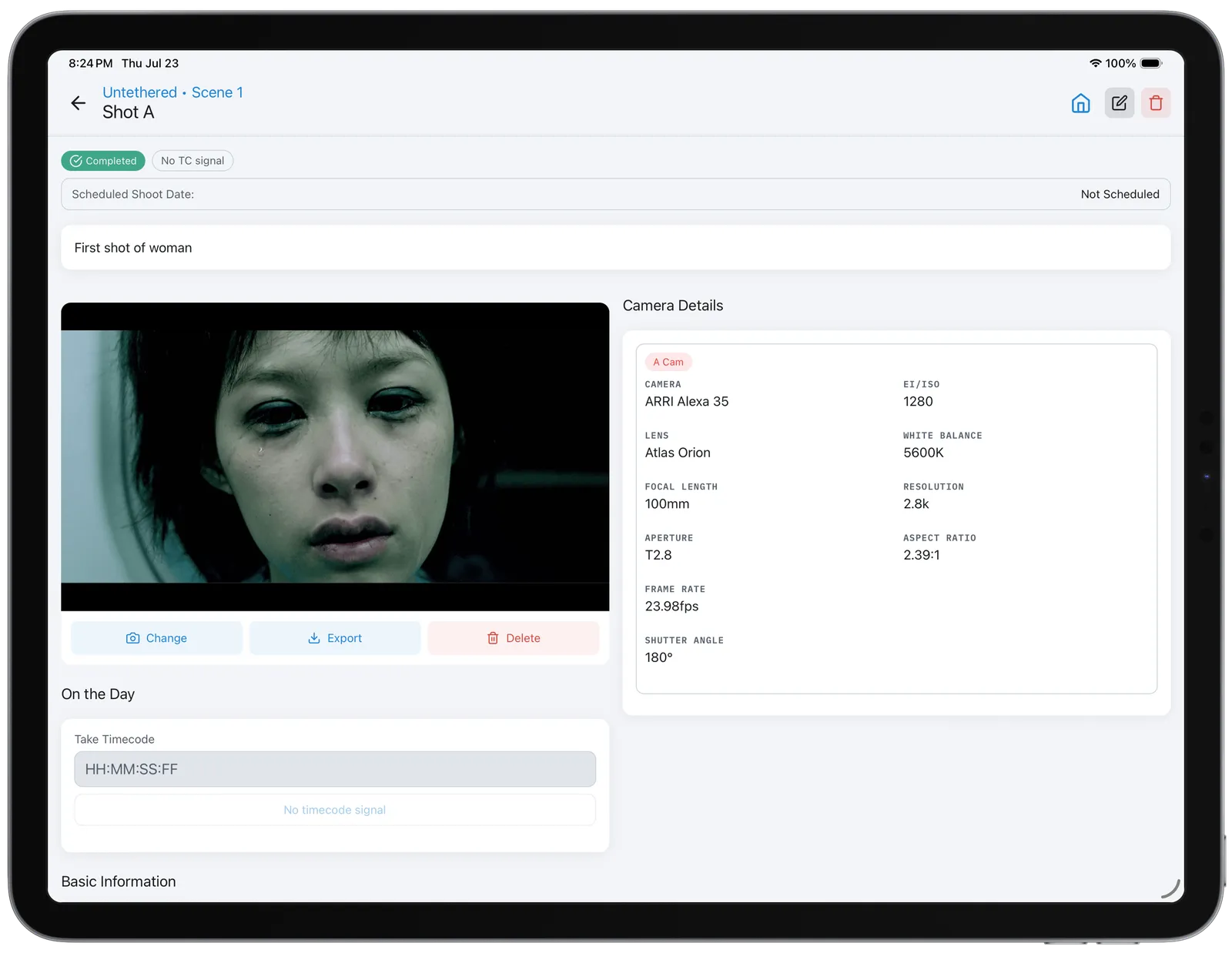
The log is where the shotlist and the continuity record touch. A shot list says what you intended to capture; the continuity log says what you actually got. On a small production those can be one document, and keeping them together is what stops the end-of-day conversation about whether scene 14 is finished from becoming a guess.
The Daily Production Report
The daily production report goes to the production office at the end of each shooting day. It records shooting times, the number of scenes and pages completed, the number of takes, and progress against the schedule.
It is the document that tells a producer whether the film is on track, expressed in the same units the schedule was built in — pages and eighths. A schedule that assumed 4 pages a day and a report that shows 2 3/8 is the earliest possible warning that the shoot is going long.
The Continuity Binder, and What Is in the Bag
The binder is the physical home of the job: the lined script, the continuity logs, the breakdown sheets, and the reference photographs. On a long shoot it becomes the authoritative record of what was shot, and it travels.
What experienced supervisors carry beyond the paperwork is fairly consistent, and every item maps to a specific failure:
- A stopwatch, because take duration is logged per take and a phone is not fast enough between resets.
- A camera, for reference frames of set dressing, wardrobe and actor positions.
- A tape measure, for reproducing an actor's mark or a camera position on a reshoot day.
- Coloured pens, because lined pages get unreadable in one colour.
- A spare copy of the script, because someone will need one and it will be you.
The digital version of the binder is the same set of information with the reference frames attached to the row they belong to, rather than living in a phone's camera roll where nobody can find them three weeks later.
What Breaks When Nobody Is Doing the Job
Most small productions do not have a script supervisor. Commercials, music videos, documentaries and small narrative shoots frequently run without one. That is a legitimate choice, but the work does not disappear — it gets absorbed, badly, by people already doing something else.
The specific failures, in the order they usually appear:
- Coverage gaps found in the edit. Nobody tracked which angles actually got shot, so a moment exists only in the wide. This is the expensive one, because the fix is a reshoot.
- Physical mismatches. A glass full in one angle and half empty in the reverse. A jacket on, then off, then on. Cheap to prevent, impossible to fix cleanly.
- No circled takes. Editorial watches everything, which costs days.
- Screen direction breaks. Two characters looking the same way in a conversation, because nobody was tracking eyelines across setups.
- The day's progress is unknown. Without a report, "are we behind?" is answered by feel.
Covering Continuity Without a Script Supervisor
If you cannot hire one, decide explicitly who is covering which part. The failure mode is assuming someone is.
| Job | Who realistically covers it | Minimum viable version |
|---|---|---|
| Coverage tracking | 1st AD or director | Tick every shot off the shotlist as it is completed |
| Circled takes | Director, called aloud | Mark the take in the shot list row |
| Timing | 1st AD | Note run time on the master only |
| Wardrobe, hair, props | The relevant department | A photo on a phone before the first take of each setup |
| Screen direction | DP | Note eyeline direction with the setup |
| Daily progress | 1st AD or producer | Pages completed against pages planned |
Two things make this workable rather than aspirational:
- Photograph before you shoot, not after. A reference frame of the set and each actor before the first take costs fifteen seconds and resolves nearly every physical continuity argument. This is the single highest-value habit for a crew with no script supervisor.
- Keep the record in the shot list, not in a second document. A separate continuity log that nobody is dedicated to maintaining will drift within a day. A status and a note on the shot list row you are already working from will not.
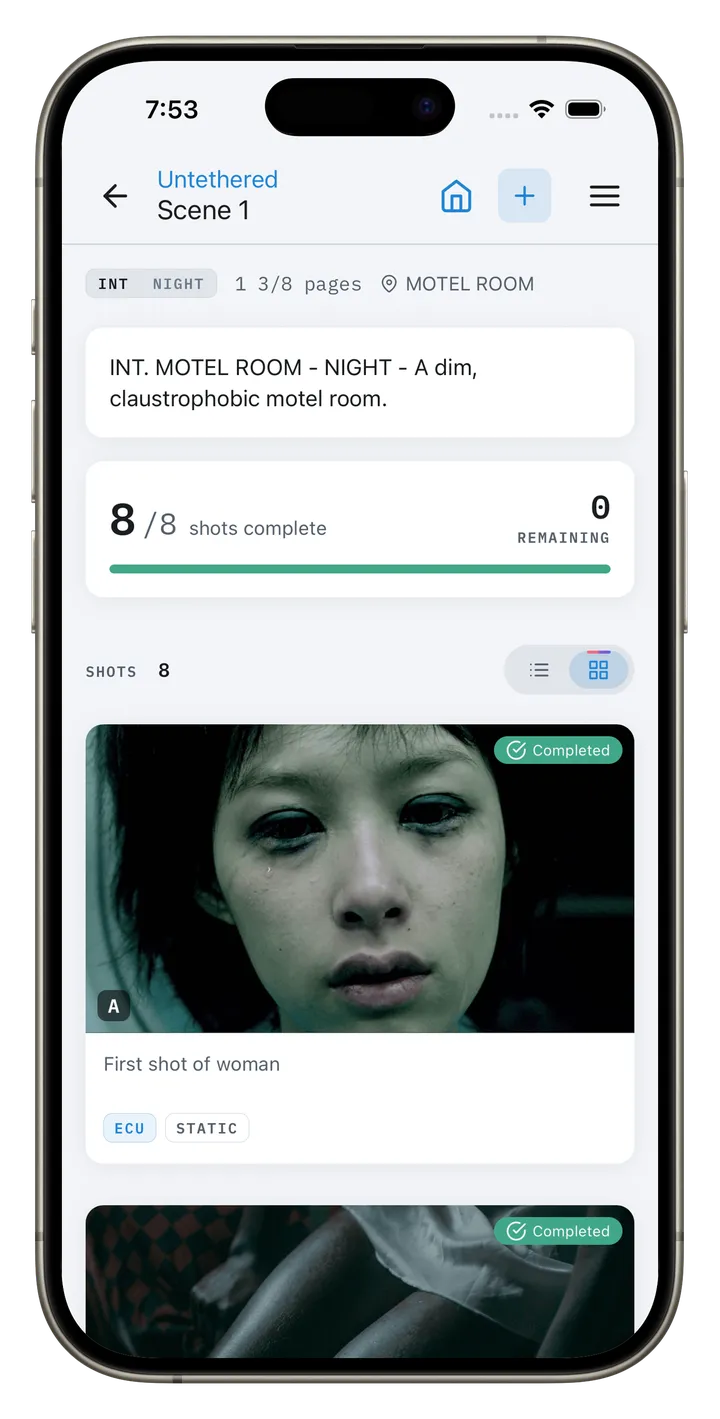
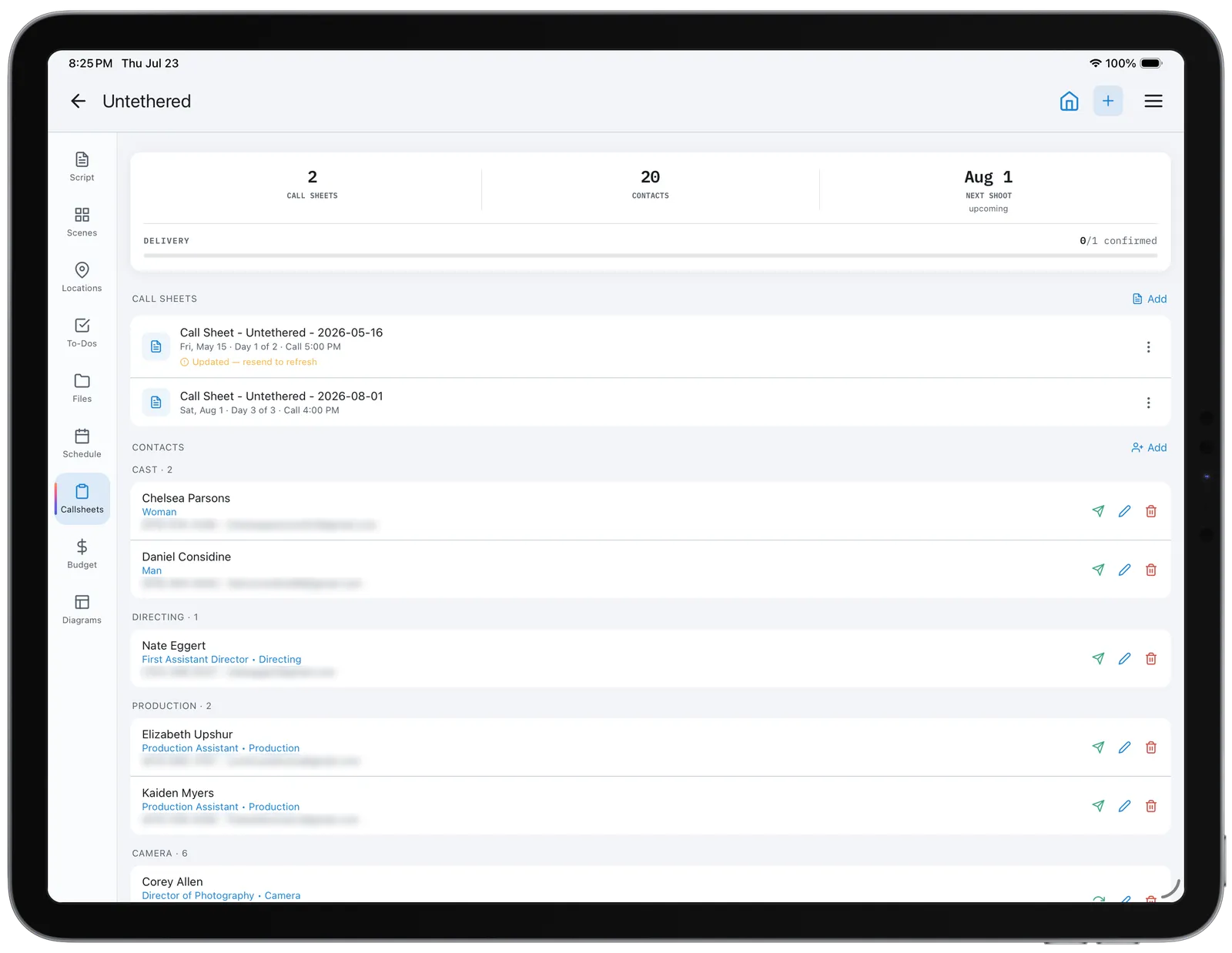
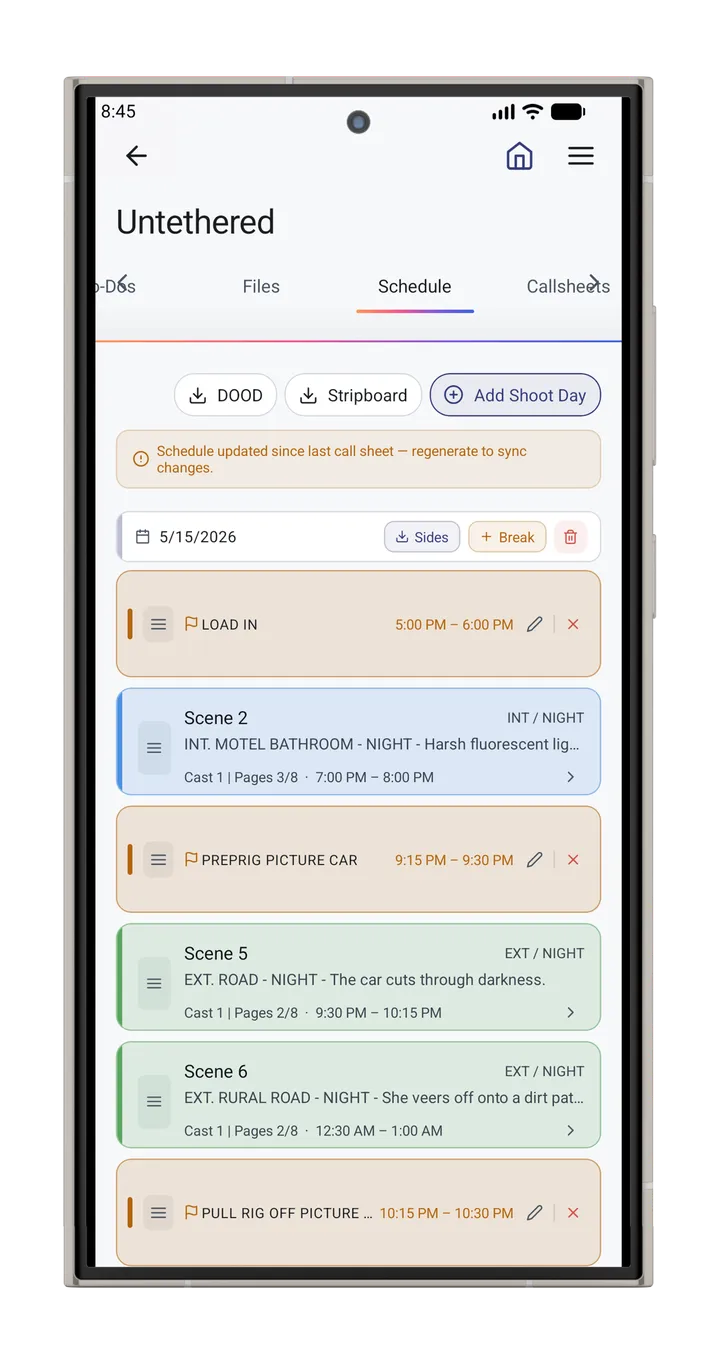
That is the workflow CineFlo is built around: one row per setup, with the plan and what actually happened in the same place. It does not replace a script supervisor on a show that can afford one. It does mean the information exists on a show that cannot.
Where the Script Supervisor Sits in the Crew
The script supervisor is not part of the camera, grip, or art departments. They report to the director and work most closely with the director, the DP, and editorial, which is why Wikipedia frames the role as the editor's representative on set.
In practice they sit next to the director at the monitor, because that is where both the performance and the coverage can be watched at once.
Terms used here: sides, page count (eighths), stripboard.
Frequently Asked Questions
Is a script supervisor the same as continuity?
Yes. They are two names for the same job. Script supervisor is the standard US credit and continuity is common in the UK and Commonwealth. Historical titles for the same role include continuity clerk and script girl.
What does a script supervisor do?
They record what happens on every take so the film can be edited: timing, action, actor positions, screen direction and lens, plus wardrobe, hair, makeup and prop continuity. They produce the lined script, the continuity log and the daily production report.
What do script supervisor notes look like?
Take-by-take rows recording scene, slate, take, whether it was circled, the duration, and what happened in the take, alongside a lined script showing which camera setup covers which portion of each scene.
What department is a script supervisor under?
They are not in a technical department. They report to the director and function as editorial's representative on set, working closely with the director and the director of photography.
Is a script supervisor an entry level job?
No. It requires reading coverage, tracking screen direction, and understanding how a scene will be cut, which is judgment that comes from experience on set. People do enter the craft as trainees or assistants to an established supervisor.
How much do script supervisors make?
Rates vary widely by market, budget tier and whether the production is union. There is no single reliable figure, and any number quoted without a market and a year attached is not worth planning against. Check the current rate card for your local union or guild.
What is a lined script?
A copy of the shooting script with a vertical line drawn down the page for each camera setup, running through the part of the scene that setup covers. It shows editorial at a glance which angles cover which lines.
Do you need a script supervisor on a small shoot?
Not always, but the work still has to happen. Decide explicitly who is tracking coverage, circling takes, and photographing set and wardrobe before each setup. The failure on small crews is assuming someone is doing it.
Key Takeaways
- Script supervisor and continuity are the same job under two names, US and UK respectively.
- The role produces three documents: the lined script, the continuity log, and the daily production report.
- Per take they record duration by stopwatch, action, actor position, screen direction and lens, alongside wardrobe, hair, makeup and props.
- The lined script is the most useful artifact, because it answers editorial's constant question: is this moment covered from another angle?
- A circled take is the one the director wants used, marked at the time of shooting.
- Without a script supervisor the work does not vanish, it gets absorbed badly. Assign each part explicitly.
- Photograph the set and the actors before the first take of each setup. It is the highest-value habit for a crew with nobody in the role.